Metatarsus Adductus
If you’ve noticed your baby’s feet are curving inward or they appear to be slightly “banana-shaped”, it is entirely possible they might have a condition known as Metatarsus Adductus. This common congenital foot deformity affects both infants and young children and is one of the most frequent reasons parents visit our clinics.
At Gold Coast Foot Centres, our experienced team understands how worrying it can be to see a difference in your baby’s feet. That is why we specialise in assessing and treating a range of pediatric foot conditions. This includes in-toeing in infants, foot curvature in children, and other developmental foot issues.
Don’t worry. With early assessment and gentle care, we can effectively manage most cases of Metatarsus Adductus without the need for surgery.
What is Metatarsus Adductus?
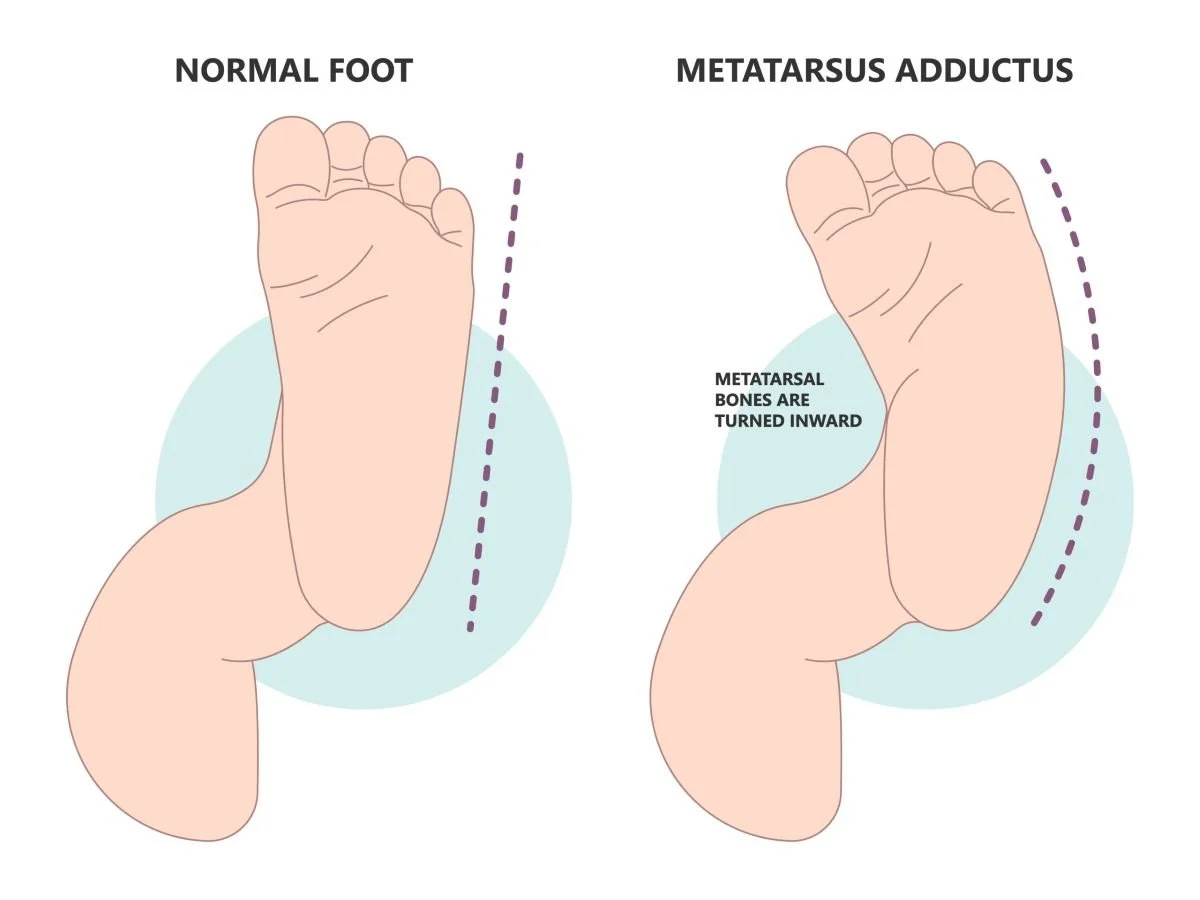
Metatarsus Adductus is a pediatric foot condition where the front part of the foot (forefoot) curves inward, while the heel remains in its normal position. This gives the foot a distinctive curved appearance. Often it is described as being “banana-shaped”.
The condition is considered a positional foot deformity. This means it develops before birth. Typically, it occurs when a baby’s feet are positioned or compressed inside the womb. This causes the bones in the forefoot to angle inward.
This affliction is quite common among children and is usually flexible. Subsequently, the foot can be gently moved into a normal position. In some cases, it can be rigid, which limits movement. Therefore, it is essential to recognise the difference between the two to determine the appropriate approach to treatment.
How Does Metatarsus Adductus Differ From Clubfoot and In-Toeing?
Many parents often confuse Metatarsus Adductus with clubfoot or other types of in-toeing in infants. However, these are distinct conditions.
In Metatarsus Adductus, only the front half of the foot curves inward. The heel and ankle remain straight. But with clubfoot, both the heel and forefoot turn inward and downward. This makes it more severe and less flexible.
Unlike internal tibial torsion (where the lower leg bone rotates inward) or femoral anteversion (where the thigh bone turns inward), Metatarsus Adductus only affects the foot itself. Knowing this difference is important because it helps parents understand that a baby's foot turning inward is not always a sign of a serious deformity.
If you’re unsure whether your child’s feet show baby foot alignment changes from clubfoot or another issue, it is worth making an appointment with one of our pediatric podiatrist clinics on the Gold Coast. They will assess and accurately diagnose the condition and clearly explain the difference to you.
What Are The Causes and Risk Factors of Metatarsus Adductus?
The exact cause of Metatarsus Adductus isn’t always known. However, several factors can increase the likelihood that your child will develop it.
Most commonly, it results from the baby’s position in the womb. This is especially true if space was limited for them during late pregnancy. This is more likely in multiple pregnancies (such as twins or triplets) or when the baby is in a breech position.
Other potential risk factors include:
A family history of foot deformities or developmental foot issues
Being a firstborn baby (due to a tighter uterus)
Premature birth or low amniotic fluid
In some cases, the condition can appear after birth. Often this is due to habitual sleeping or sitting positions that keep the feet turned inward. Again, it is essential to understand the cause as early as possible. This will help guide the best approach to countering it.
What Are The Signs and Symptoms to Watch Out For?
The condition of Metatarsus Adductus is usually noticed soon after birth or in the first few months of life. When it arises, parents might see:
A curved foot shape where the toes point inward.
A wider gap between the big toe and the second toe.
The outer edge of the foot appears curved or convex.
Flexible foot movement, which allows you to gently straighten the foot with your hand
In most cases, the condition is not painful. However, if left untreated, it is possible that more severe or rigid deformities can result in your child experiencing walking difficulties later in their childhood.
Our expert podiatrists will assess foot curvature in children using gentle tests. They will establish whether the condition is flexible or rigid Metatarsus Adductus. From that, they can determine whether foot straightening therapy or observation is the best course of action.
How Our Podiatrists Assess and Diagnose Your Child
The process of diagnosing Metatarsus Adductus is actually quite simple and painless. During your appointment, one of our pediatric foot specialists will examine your child’s feet, hips, and legs. The main purpose of doing so is to check their alignment and flexibility.
The assessment may include:
Gently manipulating the foot to see how easily it can be straightened
Observing how your baby moves or kicks
Checking for other developmental foot issues or leg alignment differences
An X-ray to rule out clubfoot or bone abnormalities.
At Gold Coast Foot Centres, our experienced podiatrists understand the importance of accurately diagnosing Metatarsus Adductus. By doing this, they can determine whether the issue will resolve naturally or if gentle podiatry treatment for babies is necessary.
What Treatment Options Are There?
Thankfully, the majority of Metatarsus Adductus cases will resolve themselves naturally as the child grows and begins to walk. However, depending on the severity and flexibility of the condition, our podiatrists may recommend specific treatment for Metatarsus Adductus.
Here is an overview of all of them.
1. Observation and Gentle Stretching
For babies with mild and flexible cases, parents may be encouraged to perform stretching exercises for their feet at home. Generally, these are simple movements that our team will demonstrate to you. They will help guide your little one’s foot back into a straight position over time.
A good time to administer this stretching is during nappy changes.
2. Corrective Footwear or Orthotics
In moderate cases, your podiatrist may recommend corrective footwear for children or soft orthotics for children’s feet.
They can help guide natural foot alignment in babies. Additionally, they can prevent recurrence and support their proper alignment as your child grows.
3. Serial Casting or Bracing
For more severe or rigid cases of Metatarsus Adductus, we may recommend serial casting. This involves applying a gentle plaster cast that’s changed weekly to gradually reposition the foot.
Once the foot has improved, a removable splint or special shoes may be used to maintain the correction.
4. Surgery (Rare Cases)
Thankfully, surgery is rarely needed. It is generally considered an option in cases where other methods haven’t worked.
Over time, most children experience improvement with non-surgical correction for metatarsus adductus. This is particularly the case when they receive early care and follow-up.
Why Choose Gold Coast Foot Centres for Your Child’s Foot Health
At Gold Coast Foot Centres, we understand how concerning it can be for a parent to notice a difference in their baby’s feet. That is why our compassionate podiatrists take the time to explain your child’s condition in simple, easy-to-understand terms. They will also answer questions you may have and provide you with a personalised care plan.
Our team specialises in pediatric podiatry. Utilising modern diagnostic tools and evidence-based therapies, they possess extensive experience in treating a broad range of conditions. This includes in-toeing, flat feet, and toe walking. Therefore, they are well equipped to ensure your child receives the best possible care.
Book Your Appointment Today
If you’ve noticed your baby’s feet curve inward and you’re unsure as to whether it’s normal, our team at Gold Coast Foot Centres can help.
We specialise in assessing and treating conditions like Metatarsus Adductus, pediatric foot deformities, and in-toeing in infants. So, you can rest assured, your child will be in good hands. Their comfort and development are our top priority.
Our podiatrists will guide you on everything from the initial diagnosis and non-surgical correction to advice on footwear and ongoing care. So, please book an appointment today and let our experienced team help your child walk confidently and comfortably.
FAQs
-
In most cases, yes. Metatarsus Adductus often resolves naturally as a child begins to walk and strengthen their feet. That said, your podiatrist may continue to monitor your child’s progress to ensure they maintain proper alignment.
-
For most babies with this condition, it is not usually painless. In fact, they can move and play normally. However, if left untreated, those with severe cases can suffer from discomfort later on in their childhood.
-
Surgery is very uncommon for cases of metatarsus adductus. It is generally only considered if conservative treatments, such as stretching, casting, or orthotics, have proved to be unsuccessful.
-
If your baby’s feet remain curved beyond six months of age or the condition seems rigid, it is best to book an assessment with a podiatrist. They will determine whether your child has metatarsus adductus.